
The #1 problem with problem-solving
Academic ethics are making business dumber

Co-Creative Problem Solving for Startups
In my role as an engineering faculty member, I’m charged with enforcing codes of academic conduct that mostly stem from a single ethical admonishment to students:
Do your own work.
Everything else related to “cheating,” from plagiarism to guidance on use of large language models in academic writing seems to be some variation on this theme.
In my Engineering Business Practices class, I’m also charged with teaching teamwork.
These two principles are seemingly in opposition to one another, and students are reasonably confused when I exhort them to share information, improve one another’s ideas, and support each other in completion of their assignments.
On the one hand, the principle of “Do Your Own Work” is well-intentioned. Imagine an analogy to exercise, in which it is the trainee’s goal to become stronger. In that case, it does them little good to have someone else do their exercises. They can only become stronger by doing their own.
By analogy, engineering students must struggle through their lessons to someextent by thesleves to strengthen their mathematical problem-solving skills. That is, when the problems are well-defined, and the solutions have long ago been worked out, then students must practice on their own to develop their skills.
On the other hand, in my role as CEO of the Morozko Forge ice bath company, the last thing I want my employees and partners to be worried about is something as unproductive and silly as DOING THEIR OWN WORK. In fact, just the opposite is true.
At Morozko, I prefer that everyone share knowledge, ask questions, copy what works, and improve the quality of every companion’s thinking. For example, when an engineering student in class uses an AI engine to solve a problem for them, we typically call that “cheating”. But if one of my former students at Morozko can reach a better solution faster by learning to query ChatGPT, we will call that a great job.
How can the ethical principles I’m obliged to teach in engineering school be so at odds with the guidance that will help my technology start up succeed?
You could argue that school and business are two different context, with different objectives, and therfore ascribe to different norms, and you’d be correct. The problem is that after 16 years (or more) of academic isolationism, few of the successful students are prepared to work in a business environment that expects knowledge sharing. Instead, they enter the workforce thinking that they must hide their work or their ideas, toiling away in relative obscurity, until they can unveil their final answer for the team in all of its polished glory as if they were going to receive the A+ + + that Ralphie fantasized about in the movie Christmas Story.
All too often, I find myself disappointed to find that my employees have been hiding their interim efforts for fear that they might be judged or criticized prematurely. The problem with that is that their work can only be as good as their individual best idea, and as I wrote in How Do You Know You Have A Good Idea, almost no one can recognize a good idea in isolation.
Ideas must be shared to be improved, and every startup company needs the best ideas it can get.
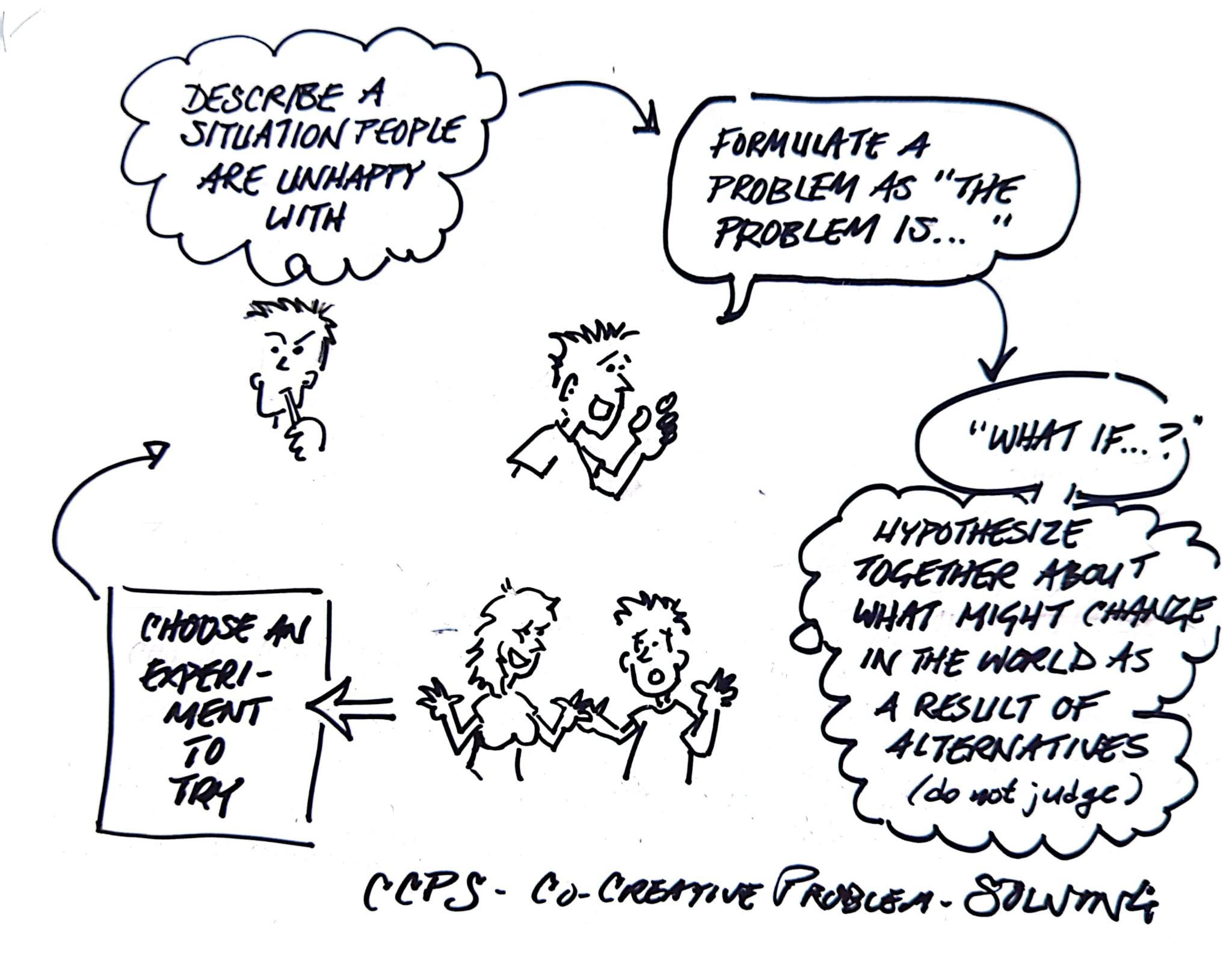
To overcome this reticence towards sharing, I’ve created an expectation of something called Co-Creative Problem Solving (CCPS) and it goes like this.
Describe the situation that you’re not satisfied with. At this stage, it’s all description. No problem formulation, no solutions, and no judgment — except for the fact that we’re not happy with things as they are. For example, a companion might say “Every time we get a repair request, we have to send a production specialist out the to customer site to investigate.”
That’s a fact, not a new idea. It’s important to come to a realistic and honest appraisal of how things are before rushing to premature problem formulation, because th act of stating a problem will simultaneously call to mind a solution. When we rush to a narrow problem statement without first coming to an understanding of the situation, too often we will miss alternative problem statements that suggest better solutions.Formulate a problem statement by completing the sentence stem “The problem is… .” This step is probably the most difficult, and the most important. I wrote a whole article called What Problem Are You Trying To Solve? on the importance of problem formulation, but I never really talked about why it’s psychologically so damn difficult to do.
Most people are trained in childhood to think that problem-based language means conflict, and they seek to avoid conflict. Imagine someone approaches you in public and accosts you with “What’s your problem?”
We all know they’re initiating conflict.
So most people learn to avoid talking about they’re problems, because they don’t think of conflict as potentially constructive. Most people want to skip over the seemingly negative emotions associated with talking about problems and get right to talking about solutions, because that’s more fun. I often have to remind people in my organizations when they skip the problem formulation step by saying, “That’s a solution, not a problem. What problem are you trying to solve?”
I probably sound like a jerk when I say it, but there’s nothing worse than investing our innovation energy in a great solution to the wrong problem.Peter Drucker is often quoted for saying, “The manager who comes up with the right solution to the wrong problem is more dangerous than the manager who comes up with the wrong solution to the right problem.”
At Morozko, we use a hierarchy for stack-ranking problems that our worthy of our attention. The highest ranking goes to customer problems, because I agree with another famous Drucker quote that goes “The purpose of business is to create customers.” So customer problems come first.
Second are problems related to productivity. When costs are too high, or quality too low, we prioritize these problems right after the customer problems. For the most part, these are Morozko problems, because customers don’t care how we provide them with solutions. They only care that our solutions create more value for them than we’re charging.
Last, we prioritize problems related to pride in craftsmanship. These are the problems that our companions care because something about our products or processes is bothering them. Putting pride of craftsmanship last might make it seem like we don’t care about pride, but I do. When I rank these three categories as I have, what I’m trying to communicate is that we will give up a little bit of pride when we can get better productivity, and we will give up a little productivity when we can better solve a customer problem. I communicate in this way not because I devalue pride, but because I want everyone at Morozko to understand what our own pride of craftsmanship might be costing.Use “What if… ?” thought experiments to brainstorm about the consequences of different alternatives. At this stage, it’s important to avoid the temptation to judge ideas, rather than think them through. A good heuristic is to adopt the improvisational theatre rule of responding with “Yes and…” to everything. When you here people say instead “Yeah, but…” you know this stage is probably going wrong.
When I was a younger man, I read a little book by Spencer Johnson MD called Yes or No: The Guide to Better Decisions (Johnson 1993) that made a big impression on me. As I recall, Johnson advised a three step process for making decisions that involved responding to three questions: 1) Am I meeting the real need?” 2) Am I informing myself of options? and 3) Am I thinking it through?Johnson never wrote about how these questions might be useful in groups working together for creative problem-solving, but his advice on the last point to “think it through” is especially applicable at the “What if… ?” stage. Johnson says that thinking it through means asking over and over again, “Then what happens? Then what happens? Then what happens?” to work out all the consequences of any alternative in your imagination before you commit more expensive resources.
Choose your first experiment. The goal of of CCPS is to improve the quality of ideas. It’s not to prove you’re right, and that’s because you should adopt the perspective that you’re wrong. As Elon Musk says, your goal is to be less wrong.
When you commit to improving the quality of each idea, the the important question becomes “Which idea should we be testing first?”
With this attitude, it’s easy to think of every decision as an experiment that is intended to generate new knowledge. That is, you and your team haven’t solved anything — you’ve only decided what potential solution you’re going to try improving first.
That’s a big decision, because testing an alternative typically requires investment of scarce time and resources. And it never feels good to discover that whatever it is that you thought you should try first doesn’t work at all. Nevertheless, the faster you find out what doesn’t work, the faster you can improve an idea until you discover something that does. In this way, CCPS is not about solutions, but about re-solutions, and re-solution of problems that evolve as you and your team reformulate them.Repeat.